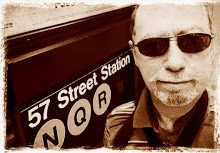
Images speak differently to each of us. Sometimes they take on other meanings not intended by their creators. This week's featured artist, Stephen Tomasko puts it best...
"For me, making photographs, especially involving people or the things that people make, is about story telling. As with any type of story, if engaged, people will bring their own history and sensibilities to round out a narrative. My goal then is to make an image beautiful and compelling enough to make the viewer want to linger, and in some way then make it their own. "
I have passed this scene many times in many cities,someone's portrait being drawn or painted.The subject sitting in anticipation, trying not to make eye contact with the viewers whose faces might reveal the results. Here she is either complacent or on edge pressing on her elbow, her hands wrenched hoping for the person she wishes to be appear on paper. I have stood in this same spot as part of this audience. Not wanting to make eye contact I too have felt the same apprehension as she does in this image making it hard to witness the end. It's a uncomfortable barrier that I can however, safely cross here via this photograph thanks to the recognition of the moment Tomasko captures. It works for me, and in this comfort zone, as Tomasko says, makes me linger.
"Boys and Girls" is about the roles that we play in our culture. It is also about the excitement and terror of relating to one another. These images were all found in the American landscape, processed minimally, and printed full-frame. Aside from being true, they are also better than any I could have concocted in my own head. Of course, they are interesting as images because of the composition and the framing, and the recognition of and reaction to the light. These things I can do. It’s for the continued supply of American weirdness and wonder that I’m reliant, always surprised and forever grateful.
Stephen Tomasko makes photographs of the natural and the man-made. He has created bodies of work with subjects as diverse as the steel and automotive industries, the life and landscape of the American city streets, and pristine blooming gardens. Tying the work together is a vision of carefully seen straight photography, presented full-frame, with minimal processing.
For more his work go here
Monday, March 21, 2011
Friday, March 11, 2011
Featured Artist...Denis Olivier
Bordeaux is mostly known for its great wine. It's also known for great photography. For wine suggestions, contact me offline..for photography look towards Denis Olivier, our new "Featured Artist."
Originally born in Royan,France where he was introduced to photography through his parents, he started by drawing later painting taking part in some exhibitions. By seventeen, he began to photograph turning his attention to it as a more interesting area of study after finnishing three years of Biochemistry. Attending the Poitiers School of Fine Arts he meets Alan Fleig who introduced him to photography as an art form.
"...felt a need to practice photography, and with a friend we spent a lot of time learning how to develop films and photographs. We did sessions with models, scenery, and discovered France."
Originally born in Royan,France where he was introduced to photography through his parents, he started by drawing later painting taking part in some exhibitions. By seventeen, he began to photograph turning his attention to it as a more interesting area of study after finnishing three years of Biochemistry. Attending the Poitiers School of Fine Arts he meets Alan Fleig who introduced him to photography as an art form.
He continued on and trained with Phillipe Salaun, the assistant to Robert Doisneau
"I did some jobs for organizations, shows and commissioned works. I then started in December 1995 working with computer graphics and made use of the Internet.
I worked in artistic direction for several years, then digital cameras came along and I found a way to work quickly and experiment without using too many resources such as film, chemicals, photo sensitive paper and of course the wonderful resource of water."
His work appears as classic Zone system for those of us who remember that. Squares, my favorite, seem to dominate his frame and help to focus on, this is his view exactly as he saw it.
Apart from his classic approach, he also has a series of manipulated images making creative compositions by blending them together, some whimsical, some haunting in his Dreamspace Reloaded series.
He has been well exhibited in France, appearing in magazines and collections.
More more of his work can be seen here
Monday, February 28, 2011
Featured Artist...John A. Benigno
"For me, the art and craft of photography are self taught. Primary influences come from the writings and works of Porter, Feininger, Steichen, and Strand, to name a few."
These are the opening lines of this week's featured artist, John A. Benigno. Taken from his resume, they help to define the inner vision he expresses on paper. More than pictures, they strike me as portraits of the souls who either have or still occupy those spaces.
These are from his collection,"Adobe Churches".
"Adobe is among the most ancient of building materials. Of the earth, and in need of constant care,
it is ideal for structures determined to endure as expressions of faith and culture.There are hundreds of adobe churches scattered throughout the high desert of the American Southwest. A few, still in existence, date back to the mid-1700's, while many others were established as far back as the early 1800's. Some are large, imposing structures, but most, built by parishioners, are small and modest. Each is unique and worth exploring. They stand as symbols of deep faith, homage to centuries old customs still practiced in towns and villages found throughout New Mexico."
John's interest in photography started as a child. His dad brought him one of the first Polaroid cameras. Toady he teaches photography at several Community Arts Centers in Pennsylvania. His work appears in many galleries and private collections throughout the country and published in various magazines.
Classic in approach, film and darkroom, today he crosses over to digital output. Still using film, he scans and then applies his formula in Photoshop, recreating his toned or tea stained technique that he applied to his silver prints.
"Perhaps, because much of my work tends towards realism, my photographs often are described as traditional. In fact, many of my primary influences come from the writings and works of photography early masters, including Porter, Feininger, Steichen, and Strand, to name a few.
While I welcome a comparison to the past, realism is merely a means to an end. Rather, I believe that my artistic vision is driven more by my background in the social sciences, especially anthropology and history, than by my great admiration for photography's early masters.My real interest is to capture timeless moments in the landscape, and, if the land has been influenced by man, to stimulate curiosity about how, when and why."
"Making a photograph is a struggle between my mind’s eye and the subject. Eventually, they merge in a peaceful coexistence. The resulting photograph becomes more than the subject. The viewer can’t possibly travel to this place with me -- it is mine. Instead, hopefully, the image before them will ignite their own internal journey to a time and place of their own. The key is to look"
More of his works can be found here.
Monday, February 14, 2011
Featured Artist...Joel Salcido
Our "Featured Artist" this week is from Austin,Texas where he currently works as an editorial and fine art photographer.
Joel Salcido started out as a staff photographer at the El Paso TImes and also traveled in Latin America for USA Today, receiving multiple awards, several for his coverage of life in Cuba and the inhalant abuse on the US-Mexican border. He worked his way to becoming Photo Editor and in 1991 he decided to branch out and pursue commercial work before his decision to move his family to Spain to work on his fine art photography.
"I made a commitment to use the camera as an instrument that would reveal beauty and truth in its simplest form. And so “Hecho en Juarez” came to be. Then came my year in Spain from which, “Spain: Millennium Past” showed me that the true wonder of tradition is anchored by an incessant human effort to celebrate life. Most recently, the “Roma: Entre Fantasmas” also follows tradition as a romantic view of local folklore in this border town where ranch, horse and religion still dominate. "
His artistic pursuit with a journalist's background marries well in his images and subject approach painting his vision with its own tone. Each body takes on its own flavor not just from what he sees but the colors he sees it through, from his portraits to his travels, with excellent technical execution as well as artistic judgment.
"As a journalist, I spent half of my career framing tragedy and disaster and sometimes glorified in it. Eventually it chipped away and eroded my hope in mankind to a skeletal resemblance of what it once was. In my need to rediscover hope, I began to seek refuge in what I deemed, “visual poetry.” "
His decision to leave the world of steady paychecks took courage and self belief in what he really wanted to achieve, he did and still does because for Joel this is more than a business, it's a love that continues producing work for publications like USA Today and Texas Highways along with collections in The Austonian, The Witliff Southwestern and Mexican Photography Collection at Texas State University-San Marcos, The El Paso Museum of Art, the Harry Ransom Humanities Center at UT Austin and Museum of Fine Arts, Houston.
His viewpoint.." For more than 20 years photography has been my companion on this journey we call life. Many times it has escorted me into the darkest corners of human existence. Other times it has opened the gates of light where visual poetry and beauty reside. Photography can easily fall into the trap of celebrating the worst aspects of ourselves and it is for that reason I continue to print my awareness of hope so in the end it may help us all understand the beauty still within us."
More of Joel Salcido's work can be seen here
Monday, February 7, 2011
Featured Artist...Andy Mars
Some artists seem to walk the line between photography and painting and our current one, Andy Mars does just that... Living in New York, Andy, a member of Professional Women Photographers, (PWP) creates her one of a kind mixed media artwork, blending water colors, acrylic paint, pastel chalks and pencil on various substrates as well as photographic paper.
She has been exhibited in many Galleries in Manhattan still finding time to volunteer service for noteworthy causes such as providing pet and family portraits to raise money for the dogs who once worked at the World Trade Towers in the aftermath of 9/11. She taught mixed media photo art to cancer survivors at the Creative Center in NYC as well as giving workshops to Senior Citizens titled "What Do All Those Buttons Do On Your Digital Camera" She recently won the "Volunteer Group of the Year Award" from Women in Need (WIN) by volunteering her service to initiate the community service committee for her group PWP.
Andy is currently a Photography Mentor (teaching photo art lessons) to a burn-accident child to improve his fine motor skills and self esteem. Her depth of sensitivity for me shows in her work, warm color, attention to the beauty within a small space, an appreciation of a single object over the big picture. They seem to be an icon for the larger landscape she stops to see.
Her abstract work shows the everyday world around her in a way that seemingly blends the real yet unreal giving a modernistic quality to her series.
More of her work can be seen ...here...
She has been exhibited in many Galleries in Manhattan still finding time to volunteer service for noteworthy causes such as providing pet and family portraits to raise money for the dogs who once worked at the World Trade Towers in the aftermath of 9/11. She taught mixed media photo art to cancer survivors at the Creative Center in NYC as well as giving workshops to Senior Citizens titled "What Do All Those Buttons Do On Your Digital Camera" She recently won the "Volunteer Group of the Year Award" from Women in Need (WIN) by volunteering her service to initiate the community service committee for her group PWP.
Andy is currently a Photography Mentor (teaching photo art lessons) to a burn-accident child to improve his fine motor skills and self esteem. Her depth of sensitivity for me shows in her work, warm color, attention to the beauty within a small space, an appreciation of a single object over the big picture. They seem to be an icon for the larger landscape she stops to see.
Her abstract work shows the everyday world around her in a way that seemingly blends the real yet unreal giving a modernistic quality to her series.More of her work can be seen ...here...
Monday, January 31, 2011
Featured Artist...Jamie Durling
From the last post of human intimate moments, we turn to one of human voidness with this week's Featured Artist, Jamie Durling in his ongoing series "Things We Left Behind"
"Inspired by my love of post apocalyptic novels and films I am creating a series of images which show a world void of people but littered with the detritus of their presence. I have shot beaches, shopping centres, cinemas and cafés eerily empty and disused in a post-human world. I want the viewer to see the 'Things' in the images as useless, redundant relics of humanity and as traces of our relatively fleeting existence. Retrospectively I can see an element of the influence the work of Eugene Atget had on me in my 'formative' years as a photographer; his empty Parisian streets fascinated me. Though his streets weren't truly empty, but rather the long shutter speeds his process required meant that people weren't around long enough to leave a trace on his images."
Residing in Weston-super-Mare, a small seaside town, in the South West of England, Jamie begins his career after graduating in 2009. Relatively new, his work shows a continuity of statement of an idea visually expressed.
"Sometimes I like to spend several days thinking about the photograph that I am going to take, even before I've picked up a camera. I normally keep a camera on me, just in case I see something that I like, because sometimes I enjoy taking photographs spontaneously."
Looking at this work, I think of the wonders that Rome, Egypt, the Mayans and all the great civilizations left behind that we now uncover with amazement, trying to decipher their meanings and usages. Will tomorrow, long after we are gone, uncover what Jamie shows us, and wonder what their usages were and how did we live, truly? If an event occurred that would wipe away all records written or recorded in any form leaving behind things represented in these images, what will they say of us?
Art is questionable by us but when it questions us directly it is to me art on a different level.
More of his work can be seen ....here
Jamie is also a fine writer as evidenced ..here
read Truth/Untruth.. my favorite.
Monday, January 24, 2011
Featured Artist...James Friedman
Art defines itself in many ways depending on who is viewing it. For some Art is beauty captured in nature, human form, colors, presentation to name a few. For others it is a cohesive concept that presented as a body of work, speaks and makes you return to look again.
"The Pleasures and Terrors of Kissing" is one of those projects, by James Friedman, inspired by his mother's passing.
As a teacher, curator, picture editor, and as a fine art, portrait, architectural, commercial and personal documentary photographer, he has enjoyed a wide-ranging career in photography. His work has been exhibited internationally and been published in numerous books and discussed in Artforum, Arts, Afterimage, The Boston Globe, The San Francisco Chronicle, The Village Voice and The New York Times. Selected from 800 international applicants, James was awarded the Aaron Siskind Foundation Individual Photographer's Fellowship and has been the recipient of seven Individual Excellence Awards from the Ohio Arts Council. Winning the 2011 Governor's Award for the Arts in Ohio, he was honored as an individual artist whose work has made a significant impact on his discipline nationally, regionally or statewide. In 2008, as an independent photographic educator without institutional affiliation, he was nominated for the prestigious Excellence in Photographic Teaching Award, which recognizes outstanding international teachers of photography.
James has many projects. Among them all this one can be found here..
"The Pleasures and Terrors of Kissing" is one of those projects, by James Friedman, inspired by his mother's passing.
"...I do not remember any kissing between family members as I was growing up. It wasn't until my mother was hospitalized for eight months, unable to speak, that we began to kiss good-bye before I would depart for the day after visiting her. These newly discovered displays of affection were imbued with genuine caring and profound sadness as we both know she had only a short time to live. Our relationship in my mother's final months inspired my photographic project."
A difficult time period, no doubt, yet James reaches deep inside and finds a meaning to explore. Perhaps it's times like that when one goes or is driven way inside that we see what would be normally apparent to our eyes but seen differently through our souls and brought to life by the artist within.
There is a beautiful line in Ashes and Snow by Gregory Colbert..."..Ever since my roof burned down, I can see the moon more clearly."
James started very young, at five, with his Brownie Hawkeye camera. Self taught his interests continued till college where he earned an B.F.A. degree with distinction in photography. Later, while earning an M.A. degree in photography from San Francisco State University, he worked as an assistant to Imogen Cunningham, one of the preeminent figures in the history of photography.
James has many projects. Among them all this one can be found here..
Monday, January 17, 2011
Featured Artist...Deon Reynolds
This week we come back to the U.S.A. and take a look at the West through the eyes of Deon Reynolds who captures its essence with his panoramic views in his series
"Where the Cowboys Once Roamed".
"...I began exploring ideas and images for ‘Where the Cowboys Once Roamed’ when I was creating scenic
photos for the coffee table book ‘NEVADA’. Originally, I was captivated by the beautiful landscapes of
the high desert".
From seven years old his interest sparked by his brother using dad's camera, a Hasselblad, he took his first lessons. On his father's advice together they built a pinhole camera out of Kodak Film boxes and learned his craft in the darkroom.
Educated in Portland at the then "Museum Art School" he began his career shooting catalogs and advertisements until he realized this was not what he really wanted to do but afforded him the freedom to pursue the artist in him.
" I began exploring ideas and images for ‘Where the Cowboys Once Roamed’ when I was creating scenic
photos for the coffee table book ‘NEVADA’. Originally, I was captivated by the beautiful landscapes of the high desert. Though, during my travels through the state I found evidence of an era gone by and realized it was deteriorating rather quickly. Around that same time, I began playing with Kodak Funsaver Panoramic 35 disposable cameras and found the format complimented the landscape while the low-fi camera quality evoked a sense of history creating the perfect look for my new found,disintegrating subject matter".
For those of us who have had the opportunity to have been out west, we have experienced what these images how well...wide open spaces with freedom to roam in a big sky country. Deon lives today with his wife Trish in Eureka in an 1880s bank building where they operate the Eureka Gallery
More of his work can be seen here
"Where the Cowboys Once Roamed".
"...I began exploring ideas and images for ‘Where the Cowboys Once Roamed’ when I was creating scenic
photos for the coffee table book ‘NEVADA’. Originally, I was captivated by the beautiful landscapes of
the high desert".
From seven years old his interest sparked by his brother using dad's camera, a Hasselblad, he took his first lessons. On his father's advice together they built a pinhole camera out of Kodak Film boxes and learned his craft in the darkroom.
Educated in Portland at the then "Museum Art School" he began his career shooting catalogs and advertisements until he realized this was not what he really wanted to do but afforded him the freedom to pursue the artist in him.
" I began exploring ideas and images for ‘Where the Cowboys Once Roamed’ when I was creating scenic
photos for the coffee table book ‘NEVADA’. Originally, I was captivated by the beautiful landscapes of the high desert. Though, during my travels through the state I found evidence of an era gone by and realized it was deteriorating rather quickly. Around that same time, I began playing with Kodak Funsaver Panoramic 35 disposable cameras and found the format complimented the landscape while the low-fi camera quality evoked a sense of history creating the perfect look for my new found,disintegrating subject matter".
For those of us who have had the opportunity to have been out west, we have experienced what these images how well...wide open spaces with freedom to roam in a big sky country. Deon lives today with his wife Trish in Eureka in an 1880s bank building where they operate the Eureka Gallery
More of his work can be seen here
Monday, January 10, 2011
Featured Artist...Massimo Siragusa
Born in Catania, Italy then later moving from Milan to Rome where he resides today, Massimo teaches photography in various schools while still finding time to publish several books.
His clean well composed images shows the attention to detail, a bright color palate makes one see the plain in an extraordinary light in contrast to his earlier works rich and darker in colors.

"...I now work with a medium format digital back PhaseOne that has replaced the large format. I have a keen interest in the study of the colours that I believe I can control better than the black and white. The only “trick” of my photos is the overexposure of each single shot to give to the image that watercolour feeling, softness and elusiveness".
He is currently represented by Polka Galerie in Paris;Forma gallery in Milan.
More of his work can be seen here.
Monday, January 3, 2011
Featured Artist...Marc Burden
It's New Year 2011, the mark of a new decade. Janus the two headed Roman god , for whom the celebration was given, faces opposite directions to look backward on last year and forward to the new one. I can't help feeling like him, sitting this weekend exhausted from last year's bittersweet moments, voided and exhilarated from the struggle, both personal and career wise, now in its depleted space...new room to be filled by the new set of challenges future rounds bring.
The work of our current "Featured Artist", Marc Burden , says all of that to me in the faces of these cage fighters from his series "The Sitting". His portraits taken just after the fight show men who whether or not they have won or lost, have paid the price for what they love.
For me art is best described as the ability to talk in whatever medium, to the one who listens with whatever sense. It's not always about beauty nor grandeur and often not what was meant by the one speaking. It's simply communication on a deeper level.
More of Marc Burden's work can be found here
![]() |
| Darren Guisha |
"...My photography explores this psychological space within the portrait, and the notion of the photographer’s and the medium’s ability to pierce the causal representation of that which sits within it. If the screen is the mediation of its relational structure, can the screen be pierced,
can a glimpse be elicited of what lays beyond "?
For me art is best described as the ability to talk in whatever medium, to the one who listens with whatever sense. It's not always about beauty nor grandeur and often not what was meant by the one speaking. It's simply communication on a deeper level.
![]() |
| Kev Reid |
"...The Sitting operates at the confluence of the oft-conflicting desires, and the gazes of the
camera, the spectator and the subject, interrogating the portrait as being analogous of a
screen. In most cases the screen is seen as protective, or it is used to obscure and conceal,
at its most opaque the portrait separates by a process of exclusion, the camera’s scrutiny
eliciting a self-conscious projection to deflect its gaze - what Lacan termed the ‘Mask’- the
projection of a second skin employed to deflect the gaze of other(s) acting as a surface onto which the image and the power of the gaze are deflected or are reflected mirror like.But the screen can be translucent too allowing glimpses - if only for the briefest of times - that hint at what may be beneath and beyond, moments when that protective layer slips or is not consciously in play ".
camera, the spectator and the subject, interrogating the portrait as being analogous of a
screen. In most cases the screen is seen as protective, or it is used to obscure and conceal,
at its most opaque the portrait separates by a process of exclusion, the camera’s scrutiny
eliciting a self-conscious projection to deflect its gaze - what Lacan termed the ‘Mask’- the
projection of a second skin employed to deflect the gaze of other(s) acting as a surface onto which the image and the power of the gaze are deflected or are reflected mirror like.But the screen can be translucent too allowing glimpses - if only for the briefest of times - that hint at what may be beneath and beyond, moments when that protective layer slips or is not consciously in play ".
![]() |
| Steve Dossett |
"...The series takes as its subject those practised in the projection of the mask: fighters, specifically cage fighters for whom the mask is a shield of intimidation, invincibility and is devoid of emotion, the nature of their combat though, drains them both mentally and physically. The camera acts as a barrier visually and mentally, a screen divorcing contact and interaction between the photographer and the sitter, the images document moments that are emporally random and un-decisive, the absence of interaction leaving the exhausted sitter
isolated. By eschewing the intimacy and mediation conventionally associated with the portrait the images explore the visual psychological states in unconscious compositions that dislodge and disarm the surface before the scrutiny of the camera. The resulting portraits reveal not the conscious projection of an identity but a space between that and their unconscious; the isolated figures are seen in liminal moments characterized by ambiguity, openness, and
indeterminacy ".
isolated. By eschewing the intimacy and mediation conventionally associated with the portrait the images explore the visual psychological states in unconscious compositions that dislodge and disarm the surface before the scrutiny of the camera. The resulting portraits reveal not the conscious projection of an identity but a space between that and their unconscious; the isolated figures are seen in liminal moments characterized by ambiguity, openness, and
indeterminacy ".
More of Marc Burden's work can be found here
Monday, December 27, 2010
Featured Artist...Bob Hudak
I thought we would end this year here, where I live, South Florida, with images best shown by our current "Featured Artist" Bob Hudak. His views are classic photography, large format and yes film.
Self taught, he leaves his former life as pilot flying air taxis, throughout Florida and the Bahamas where he develops his taste for the landscapes he sees.

Bob takes his influence from one of the greats, Edward Weston and makes black&white photography his choice of expression.
"The photographs shown here were produced from negatives made with large format cameras. Originally, because of its relatively small size, the 4 x 5 inch view camera was my camera of choice. However, with my increasing interest in the contact printing processes and my aversion to making enlarged negatives, the 5 x 7, 8 x 10 and (soon) larger formats more likely will get the nod. However, the use of these relatively small camera sizes, in comparison to 8 x 10 inch and larger cameras, does offer a wider range of flexibility when it comes to printing. With certain subjects these negatives can be printed as contact prints or when needed as with a large landscape the 5 x7 inch negative can produce 16 x 20 inch prints of outstanding quality.
"
Since 1984, he has worked for various publications on travel adding commercial work in Architecture, Aerials, and Yacht photography and supplying stock agencies with his images. Florida becomes his choice for his work.
"My reasoning behind the Florida trips was that while the West in general and more specifically Montana does have a lot to offer the photographer working in the landscape I do not live there, and while I have returned many times it has been mostly with a fly rod to fish on the Madison, Yellowstone and numerous other rivers and streams around the state. To do something productive with a camera would require repeated visits to easily accessible, visually interesting areas; in short, I felt I needed to stay closer to home base.
The Florida that I grew up in, that is to say, South Florida in the late sixties, seventies and early eighties is, unfortunately, gone. Today’s post Disney version of Florida bears little resemblance to that period of time before the floodgates were opened and the mass influx of new residents hit my part of the state. The booming population and the infrastructure needed to support it, guaranteed that the lakes and woods used by myself and my friends as our escape from the real world would soon be filled in, paved over and lost forever under a sea of concrete and asphalt, never to be seen again except in memory."
His love of the outdoors continues to draw his attention adding to an over 16 year project dedicated to personal vision and viewpoint.
"As a photographer working with a landscape that now exists only as a fraction of the place you once knew, the challenge is to bring an awareness to the land through your photographs without resorting to sentiment in the hope of protecting what little we still have left, knowing that loosing this, it too is gone forever.
With these photographs my hope is to engage the viewer in a way that conveys not only a love of the land but also acknowledges the presence of something spiritual. Not spiritual in a biblical meaning, but something deeper, more to do with the belief that there is this unseen force in the universe larger than ourselves we can’t understand and that science and religion can’t explain. More than once it has been suggested to me that my photographs of the Florida landscape have been subconsciously my attempt to bring back the Florida that was, and in doing so recapture my youth and that, which disappeared with it. I’ve never had an intelligent reply to that comment; however if these images succeed at all then maybe what I’ve been doing for the past eighteen years hasn’t been a search for what I’ve lost of myself, but rather a search for the manifested Gods that are to be found within these lands."
For more of his work
Monday, December 20, 2010
Monday, December 13, 2010
Featured Artist...Yvette Worboys
It's always good to see what is happening around
the world in photography. Some come from "Across the Pond" but Yvette Worboys hails from " Down Under, " Sydney Australia to be exact. Her graphic design background shows in her work "ghosts"
Yvette is a professional photographer and has been working within the industry since 2002. Yvette began her creative career as a graphic designer and she combines both her love of design and photography within her work. After completing her studies in 2003 Yvette began working in the domestic portrait market while continuing to pursuer her love of fine art photography. She has been a successful exhibiting artist in Australia being selected for various shows including the prized Olive Cotton Award for portraiture.
Yvette is currently working on a body of work using color and shapes as the main focus of the images. This body of work will hopefully be exhibited in Sydney Australia in 2011. She uses a vast array of equipment from the iPhone 4 Hipstamatic camera, Lomography cameras such as Holga, Canon 35mm film and digital cameras and a Bron 6 x 6 film camera. Her post production process involves mainly Photoshop however Lightroom is used for batch processing and selecting of images.
Yvette wishes to capture not just the person or place she is photographing but also the stories behind them, as evident in herCommunity exhibition, a study on the northern NSW town of Mullumbimby, Australia. This exhibition told the stories of the town from the local’s perspective. This exhibition was held in Sydney and then travelled to Mullumbimby.
Her work below right is from "Surrealist"
More of her work can be seen here
Monday, December 6, 2010
Featured Artist...Stuart McCall
This week we receive work through the eyes of Stuart McCall, a Vancouver, BC based photographer, who shows us his panoramic scenes of the deserts of Nevada and northern Mexico.
He began his career as a commercial photographer in 1982. Since then, his images have been published widely, featured in Time Magazine, Fortune Magazine, Saturday Night, Photography Monthly, Boston Globe, Times of London, as well as in books by National Geographic and Douglas & McIntyre. His work has been recognized by Communication Arts, the Lotus Awards, and International Photography awards.
"The desert has fascinated me for some time. It is a place where the climate and environment are quite incompatible with human survival. Scarcity of water, and extremes of heat and cold are typical… Yet people have been inhabiting and trying to make a living in deserts since time immemorial. Many come, but few stay on. The extremes of climate have the ability to preserve traces of past activity in a remarkable way that is not so much the case in wetter or more moderate climate. Structures, roads, footpaths, machinery, fences, and garbage heaps tend to linger on in an unnatural way, far beyond what their creators anticipated. I have for the past several years developed a keen interest in remains left behind and eventually becoming a part of the landscape. The deserts of western North America are wonderful places to study this."
He completed his series of desert scenes in 2010, using small digital equipment as series of overlapping frames,combined in post-production,creating a seamless panoramic image that really shows it better effect here . He has been experimenting with this technique for a couple of years and found the possibility of extremely high image quality with the convenience of small format appealing.
"The desert has fascinated me for some time. It is a place where the climate and environment are quite incompatible with human survival. Scarcity of water, and extremes of heat and cold are typical… Yet people have been inhabiting and trying to make a living in deserts since time immemorial. Many come, but few stay on. The extremes of climate have the ability to preserve traces of past activity in a remarkable way that is not so much the case in wetter or more moderate climate. Structures, roads, footpaths, machinery, fences, and garbage heaps tend to linger on in an unnatural way, far beyond what their creators anticipated. I have for the past several years developed a keen interest in remains left behind and eventually becoming a part of the landscape. The deserts of western North America are wonderful places to study this."
Stuart has several projects which have been in various exhibitions . Hos work continues to evolve with his current approach.
" The notion of a planet absent of human beings has been of interest for some time, and has been cause for expression in my work. While many imagine a future where man and nature will return to a state of equilibrium, my current work considers a world where nature is gradually reversing the effects of a brief encounter with humanity."
More of his work can be seen here
He began his career as a commercial photographer in 1982. Since then, his images have been published widely, featured in Time Magazine, Fortune Magazine, Saturday Night, Photography Monthly, Boston Globe, Times of London, as well as in books by National Geographic and Douglas & McIntyre. His work has been recognized by Communication Arts, the Lotus Awards, and International Photography awards.
"The desert has fascinated me for some time. It is a place where the climate and environment are quite incompatible with human survival. Scarcity of water, and extremes of heat and cold are typical… Yet people have been inhabiting and trying to make a living in deserts since time immemorial. Many come, but few stay on. The extremes of climate have the ability to preserve traces of past activity in a remarkable way that is not so much the case in wetter or more moderate climate. Structures, roads, footpaths, machinery, fences, and garbage heaps tend to linger on in an unnatural way, far beyond what their creators anticipated. I have for the past several years developed a keen interest in remains left behind and eventually becoming a part of the landscape. The deserts of western North America are wonderful places to study this."
He completed his series of desert scenes in 2010, using small digital equipment as series of overlapping frames,combined in post-production,creating a seamless panoramic image that really shows it better effect here . He has been experimenting with this technique for a couple of years and found the possibility of extremely high image quality with the convenience of small format appealing.
"The desert has fascinated me for some time. It is a place where the climate and environment are quite incompatible with human survival. Scarcity of water, and extremes of heat and cold are typical… Yet people have been inhabiting and trying to make a living in deserts since time immemorial. Many come, but few stay on. The extremes of climate have the ability to preserve traces of past activity in a remarkable way that is not so much the case in wetter or more moderate climate. Structures, roads, footpaths, machinery, fences, and garbage heaps tend to linger on in an unnatural way, far beyond what their creators anticipated. I have for the past several years developed a keen interest in remains left behind and eventually becoming a part of the landscape. The deserts of western North America are wonderful places to study this."
Stuart has several projects which have been in various exhibitions . Hos work continues to evolve with his current approach.
More of his work can be seen here
Subscribe to:
Posts (Atom)